Pruning a hydrangea is one of those jobs where a single cut in the wrong month can cost you an entire summer of flowers. The plant won't sulk or send up a warning flag. It grows a handsome mound of leaves, produces nothing, and leaves you staring at it in July wondering what went wrong.
The answer is usually timing, and timing comes down to one question: does your hydrangea form its flower buds on old wood or on new? Work that out, and the calendar takes care of itself.
Old Wood, New Wood, and How to Tell Them Apart
Old wood is growth the plant made last season and kept through winter. New wood is what pushes out this spring. Some hydrangeas set flower buds on old wood the previous summer, and those buds sit dormant and fully formed, waiting for warm weather. Others start from scratch each year and bloom on stems grown in the same season.
In spring the difference is easy to see once you know where to look. Old stems are gray-brown and firm, sometimes with bark peeling in strips on the oldest growth. Buds sit along them like small tight beads, and on a bigleaf hydrangea the buds at the tips are noticeably fat and rounded. Those are flowers in waiting. New shoots are soft and green, often rising from the base or from low buds on the stems.
The practical translation: if flower buds are already sitting on the stems when winter ends, prune as soon as the flowers fade. If the plant has to grow fresh stems before it can bloom, prune in late winter or early spring.
Identify Your Hydrangea First
Leaves and flowers give it away faster than labels do. Go outside and look at the plant, or at photos of it from last summer.
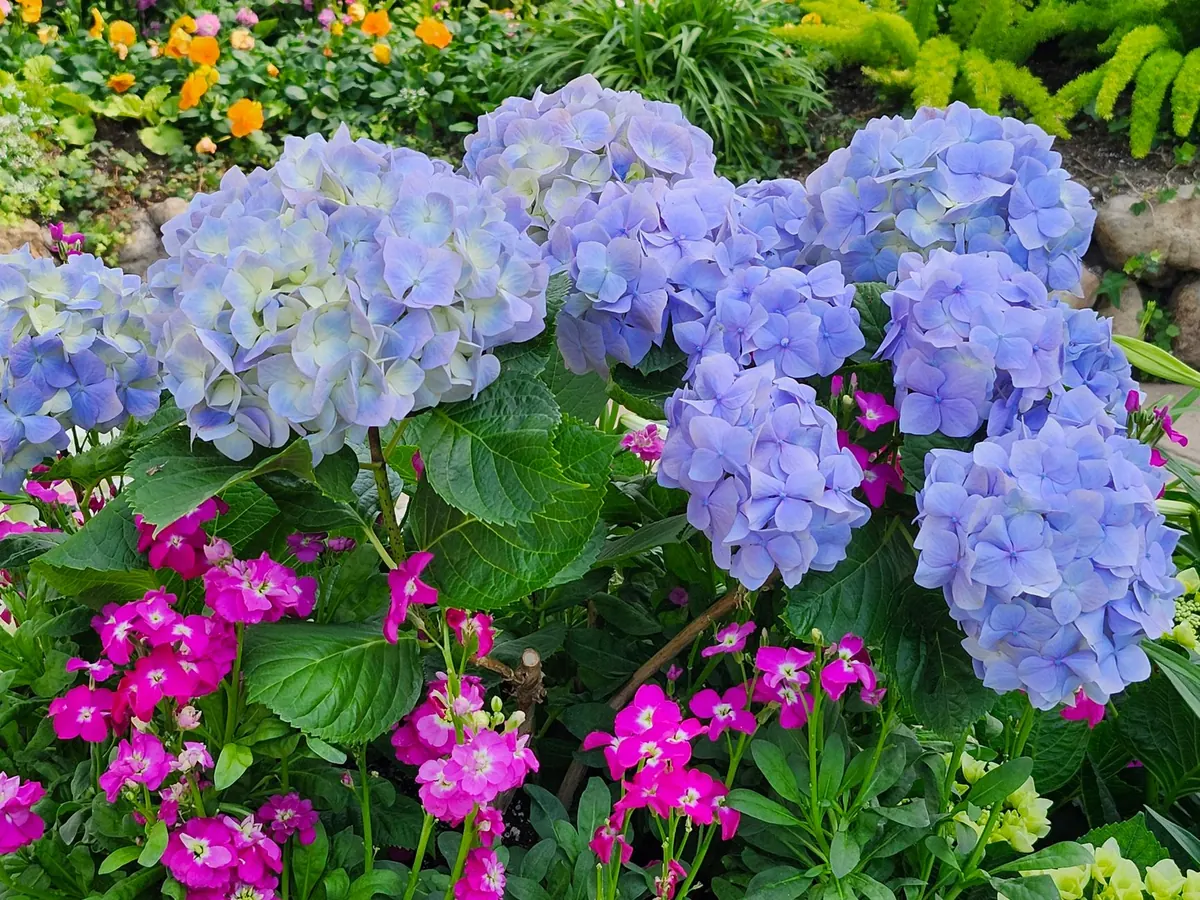
- Bigleaf (Hydrangea macrophylla): the classic mopheads and lacecaps in blue, pink, purple or white, with broad, coarsely toothed leaves. Blooms on old wood, unless it's a reblooming variety.
- Mountain (H. serrata): smaller leaves, finer stems, lacecap flowers. Old wood.
- Oakleaf (H. quercifolia): deeply lobed leaves that turn burgundy in autumn, cone-shaped white flowers. Old wood.
- Climbing (H. anomala petiolaris): a vine with white lacecap flowers in early summer. Old wood.
- Panicle (H. paniculata): long pointed cones on 'Limelight', 'Bobo' and 'Pinky Winky'. New wood.
- Smooth (H. arborescens): the big round white balls of 'Annabelle' and 'Incrediball'. New wood.
If the tag is long gone and you're genuinely unsure, don't cut anything this year. Watch when it blooms. Flowers in early to midsummer on stems that existed last year means old wood; flowers in late summer on growth made that same season means new wood.
Pruning Old-Wood Bloomers
Bigleaf, mountain, oakleaf and climbing hydrangeas should be pruned right after they finish flowering, and no later than early August in most climates. The plant needs roughly six to eight weeks of growing weather after pruning to set next year's buds. Trim in late September and you're cutting away flowers the shrub has already made.
What that looks like in practice:
- Deadhead as each flower fades. Cut the stem back to the first strong pair of leaves below the flower head, not to the ground.
- Remove anything dead, damaged or crossing through the middle of the plant.
- Take out two or three of the oldest stems each year, cutting them at the base. This keeps the shrub young instead of letting it become a thicket of tired wood.
- Stop there. A light renovation each year beats a hard chop every five.
Reblooming varieties such as 'Endless Summer' and 'BloomStruck' flower on old and new wood, so a spring prune costs you the first flush but not the season. That makes them forgiving choices for cold gardens.
In zone 5 and colder, bigleaf buds often freeze no matter how well you prune. Wait until spring, then cut each stem back to the highest live bud. The scratch test is your friend: nick the bark with a fingernail. Green underneath means living wood; brown and dry means it's gone.
If you can't remember whether you pruned or not, don't panic. A year without flowers is a nuisance, but most hydrangeas recover quickly once the right timing is restored.
Pruning New-Wood Bloomers
Panicle and smooth hydrangeas are the easy ones. Prune them in late winter or early spring, just as buds begin to swell and before leaves open. They flower on growth made the same season, so you can cut them back hard without losing a single bloom.
For panicle hydrangeas like 'Limelight' and 'Bobo', cut the whole plant back by about one-third to one-half, making each cut just above a pair of outward-facing buds. This encourages a sturdier frame and larger flower cones. If you want a taller shrub, prune lighter; if you want a compact, floriferous mound, be more aggressive. Remove any thin, twiggy stems entirely, leaving a handful of strong main branches.
Smooth hydrangeas such as 'Annabelle' and 'Incrediball' can be cut to within 12 to 18 inches of the ground every year. They bloom on new stems that rise from the base, so this hard prune actually produces bigger, better flowers and prevents the floppy stems that plague unpruned plants. In colder zones, wait until you see new growth emerging from the base, then cut back to that point.
One caution: don't prune these in autumn. The old stems provide some winter protection, and cutting them early can stimulate tender new growth that will be killed by frost.
Tools and Technique: Making a Clean Cut
Good pruning is as much about the cut as the timing. Use sharp bypass pruners for stems up to about half an inch, and loppers for anything thicker. Anvil pruners crush the stem and leave a ragged wound that invites disease, so leave them in the shed.
Always cut at a slight angle, about a quarter-inch above a bud or a pair of buds. Too close and you damage the bud; too far and you leave a dead stub that dies back and looks untidy. For stems you're removing entirely, cut flush with the main branch or the ground—don't leave a peg.
Clean your blades with rubbing alcohol between plants, especially if you've been working on one with signs of disease. Hydrangeas can suffer from bacterial wilt and fungal leaf spots, and a dirty tool is the fastest way to spread them.
When Not to Prune: The Big Mistakes
Knowing when to prune is only half the story. Knowing when to stop is the other half.
- Don't prune old-wood hydrangeas in late summer or autumn. You'll cut off next year's flower buds, which are already formed inside the stems.
- Don't prune any hydrangea while it's in bud or in full flower unless you're deadheading. You'll sacrifice the display you've been waiting for.
- Don't hard-prune climbing hydrangeas. They bloom on old wood and resent heavy cutting. Limit yourself to tidying wayward shoots after flowering.
- Don't cut reblooming bigleafs to the ground in spring if you want early flowers. You'll get a later flush instead, which may be fine in cold climates but disappointing in mild ones.
- Don't prune a plant that's struggling for other reasons. If a hydrangea is wilting, yellowing, or pest-ridden, fix the underlying problem first. Pruning adds stress.
Renovating a Neglected Hydrangea
Sometimes you inherit a hydrangea that hasn't been touched in a decade. It's a tangle of dead twigs and crossing branches, and flowers are sparse. You have two options depending on the type.
For old-wood bloomers, renovate over three years. Each year after flowering, remove one-third of the oldest stems at the base. By the end of the third year, the whole shrub is young again, and you haven't lost a season of bloom. Trying to do it all at once means a year or two without flowers—sometimes worth it, but usually not necessary.
For new-wood bloomers, you can be ruthless. In late winter, cut the entire plant back to 12 to 18 inches from the ground. It will look brutal for a few weeks. Then it will explode with fresh growth and produce more flowers than it has in years. Panicle hydrangeas respond especially well to this treatment, often doubling their bloom count.
Aftercare: Helping Pruned Hydrangeas Recover
A pruned hydrangea is a thirsty hydrangea. Water deeply once a week if rain is scarce, especially during the first month after pruning. A two- to three-inch layer of mulch—compost, bark chips, or shredded leaves—will keep moisture in and suppress weeds.
Don't rush to fertilize. If you pruned in late winter or early spring, wait until you see new growth, then apply a balanced slow-release fertilizer or a light dose of compost. Too much nitrogen encourages leafy growth at the expense of flowers. For old-wood bloomers, a handful of bone meal or a phosphorus-rich fertilizer in early spring can support bud development.
Finally, keep an eye out for pests and diseases. Fresh cuts are vulnerable, and stress can attract aphids, spider mites, and powdery mildew. Good air circulation—helped by your pruning—is the best preventive measure.
The Short Version: A Calendar by Type
If you remember nothing else, remember this:
- Bigleaf, mountain, oakleaf, climbing: prune right after flowering, by early August. Light annual thinning, not hard chops.
- Panicle and smooth: prune in late winter or early spring. Cut back by one-third to one-half, or to the ground for smooth types.
- Rebloomers: prune after the first flush if you want a second, or in late winter if you're willing to trade early flowers for a later show.
- When in doubt: wait. A year without pruning is better than a year without flowers.
Pruning isn't complicated, but it is unforgiving of bad timing. Watch your plant for a season, learn its habits, and then make your cuts with confidence. The reward is a shrub that blooms reliably, year after year, with less work than you'd think.
Photo: Alex Ohan / Pexels